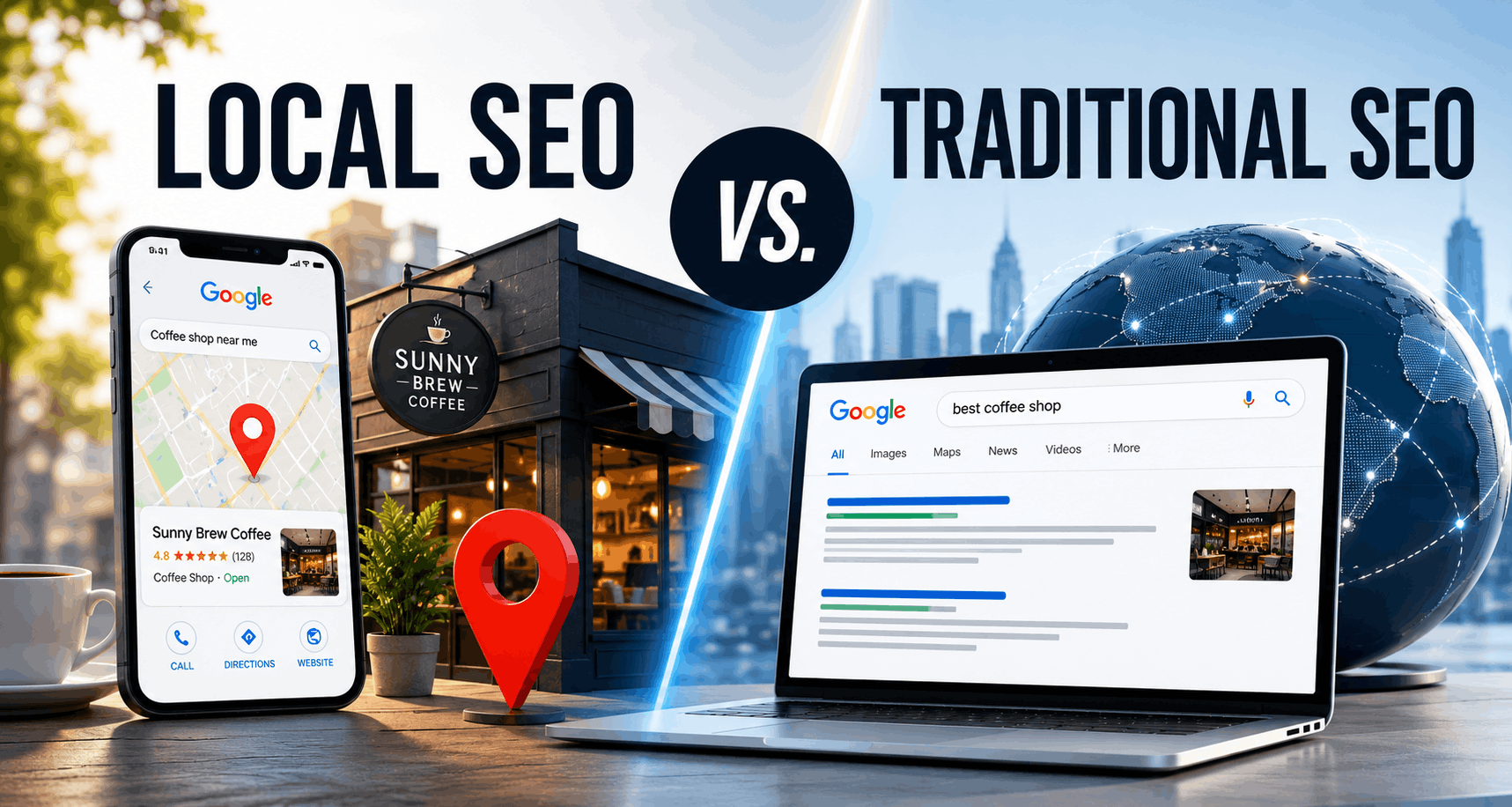
If you’ve ever Googled a business and noticed a map pop up at the top of the results with star ratings, hours, and a little red pin, that my friend, is local search optimization in action. However, if you’re a business owner trying to figure out where to put your marketing energy, understanding the difference between local SEO and traditional SEO is essential. These two strategies have similar foundations, but serve very different goals, and confusing one for the other can mean you’re not as visible as you could be and are potentially losing out on customers.
What Is Traditional SEO and Who Is It For?
Traditional SEO is the practice of optimizing a website so that it ranks higher in search engine results pages (SERPs) for broad, non-location-specific keywords. Think of an online publication for example, their goal is to reach the widest possible audience, regardless of where that person is searching from. Traditional SEO focuses heavily on content quality, domain authority, backlink profiles, site speed, and keyword targeting at a much larger scale. You’re playing the long game with traditional SEO as it tends to prioritize organic traffic volume over proximity. This works beautifully for businesses that sell or serve customers nationally or globally, but for a mom and pop bakery, Traditional SEO alone isn’t going to cut it.
How Does Local Search Optimization Actually Work?
Local search optimization is a specialized branch of SEO designed to help businesses appear in search results for geographically specific queries. So when someone searches for “best coffee shop near me” or “dentist in Austin,” the search engine is trying to match them with the most relevant option closest to them. To do this well, local SEO relies on a few tools and signals that traditional SEO doesn’t lean on nearly as much such as Google Business Profile optimization, local citations, geo-targeted keywords, and customer reviews. Local search optimization is more about showing up for the right people, in the right place, when they first look.

Why Does Search Intent Change Everything?
Search intent is one of the biggest differences between these two strategies. In traditional SEO, you might be targeting informational searches like when someone is trying to do a DIY project, compare products, or understand a concept. The user could be anywhere in the world, and they might not be looking to act right away
In local SEO, the intent is almost always high-urgency and transactional. People searching locally are typically ready to make a move right then and there. They want to visit a store, book an appointment, or call someone. This means your business hours need to be accurate, your phone number needs to be clickable, and your address needs to map correctly. These details are significantly more important for local SEO than for a traditional SEO campaign targeting a national audience.
What Role Does Google Maps Play in Local SEO?
Google Maps is arguably the most important arena in local SEO. The Google Map Pack (the three business listings that appear above the organic results for local searches) gets a massive share of clicks, often more than the traditional organic results below it.
Being able to earn a spot in the Map Pack requires a fully optimized and verified Google Business Profile, consistent NAP (name, address, phone) information across the web, strong review signals, and local relevance. Google Maps is a uniquely local playing field and especially for businesses that have a physical location, it’s one of the highest-value pieces of internet real-estate.
How Much Do Reviews Actually Matter?
In traditional SEO, reviews don’t really have much of an impact; with local search optimization, they’re a cornerstone of your ranking strategy and your reputation. Google treats reviews as a trust and relevance signal, so a business with 200 recent, high-quality reviews will consistently outperform one with 20 old reviews. But it’s not just about quantity. Having recent reviews, good response times, and the language used in reviews all play a role. When customers mention your city, your services, or specific product names in their reviews, those keywords feed back into your local relevance signals. Reviews also directly impact click-through rates. A 4.8-star rating next to your business name converts better than almost anything else you can put on a page.

Is Location-Based Visibility the Same as Ranking?
This is where a lot of business owners get tripped up. In traditional SEO, you either show up on page one or you don’t, and your ranking is largely the same regardless of who’s searching. Local search optimization works differently. Your visibility is much more dynamic and dependent on location.
For example: a restaurant might rank at the top of results for someone searching two blocks away, but fall out of the Map Pack entirely for someone who’s searching from a different part of the city. This is why local SEO requires a hyperlocal mindset because you’re trying to show up for the right searcher, in the right location radius, with the right combination of relevance, proximity, and prominence that Google uses to determine local results.
Which Strategy Is Right for Your Business?
The honest answer is it depends on who your customer is and where they find you. If you serve a specific neighborhood, city, or region, then local search optimization should be the foundation of your digital marketing strategy. It’s where the highest-intent, ready-to-buy customers are searching, and it’s where a well-optimized local presence can outcompete much larger brands simply by being closer and more relevant.
If you’re serving a national or international audience without a fixed location, traditional SEO is your best bet. Many businesses may actually need both. Like a regional law firm with multiple offices, for example, benefits from strong local search optimization at each location while also building domain authority through content marketing and backlinks.
Ready to Have Your Business Optimized?
If your business isn’t showing up when local customers are searching, you’re handing those leads over to the next business. We can fix that. Whether you need a stronger local presence or a full SEO strategy, our team at My wseo is here to help. Contact us today for a local SEO audit and find out exactly where your business stands and we’ll help you finally start ranking like you should.